
I am an economist and I hold a PhD in Economics from UCLA. I am a Senior Associate in the Antitrust and Competition Economics practice of Charles River Associates based in San Francisco. I am an External Affiliate of the California Center for Population Research at UCLA.
My academic research and professional work focus on industrial organization, regulation, and market design. My solo-authored work has been published in the Journal of Health Economics and I have presented my work on invitation in academic and regulatory outlets (U.S. Department of Justice, U.S. Congressional Budget Office, California Department of Health Care Access and Information).
Email: chandni [dot] raja [at] gmail [dot] com.
Peer-Reviewed Publications
[1] How Do Hospitals Respond to Input Regulation? Evidence from the California Nurse Staffing Mandate, Journal of Health Economics, 92, 102826, December 2023
[Paper] [Gated version] [Policy slides]
Mentions in media and policy: [Hawaii Legislative Reference Bureau Report]
Show Abstract
Abstract: Mandated minimum nurse-to-patient ratios have been the subject of active debate in the U.S. for over twenty years and are under legislative consideration today in several states and at the federal level. This paper uses the 1999 California nurse staffing mandate as an empirical setting to estimate the causal effects of minimum ratios on hospitals. Minimum ratios led to a 58 minute increase in nursing time per patient day and 9 percent increase in the wage bill per patient day in the general medical/surgical acute care unit among treated hospitals. Hospitals responded on several margins: increased their use of lower-licensed and younger nurses, reduced capacity by 16 beds (14 percent), and increased bed utilization rates by 0.045 points (8 percent). Using administrative data on discharges for acute myocardial infarction (AMI), I find a significant reduction in length of stay (5 percent) and no effect on the 30-day all-cause readmission rate. The null effect on readmissions suggests that length of stay declined not because hospitals were discharging AMI patients ``quicker and sicker", rather, AMI patients recovered more quickly due to an improvement in care quality per day.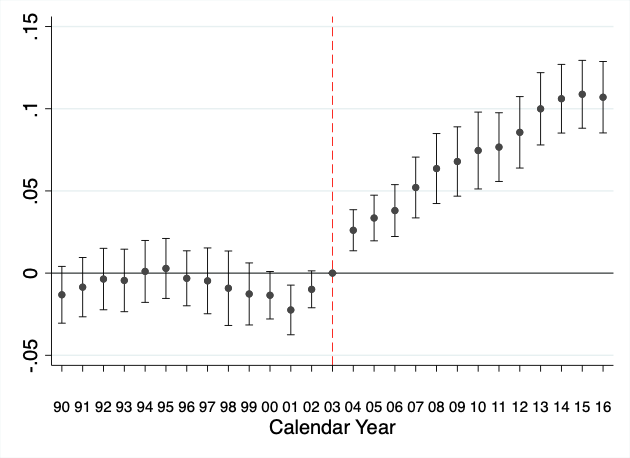
Working Papers
[2] [NEW DRAFT] Regulating Hospital Quality: Input Regulation, Factor Market Structure, and Misallocation in Healthcare, submitted
[Paper] [Supplemental Appendix] [Academic slides] [Policy slides]
Show Abstract
Abstract: This paper estimates a multi-input production model for hospital quality using identifying variation from the 1999 California nurse staffing mandate. I use the recovered production primitives to study the within- and across-hospital factor misallocation from quality regulation targeting production inputs. I find that nurses and physicians are highly complementary inputs (near Leontief) and regulation targeting only nurses increases annual costs by 0.5 percent (\$10 million) holding quality constant. Misallocation is doubled under second-best where the mandate exacerbates understaffing of physicians at low revenue, government, and rural hospitals. I find no evidence of across-hospital misallocation of nurses to low productivity hospitals due to the regulation – low staffing hospitals are as productive as their high staffing neighbors. However, relative to a mandate that sets the same input floor for all hospitals, I find aggregate efficiency gains can be made by reallocating nurses to higher severity hospitals where labor is more valuable.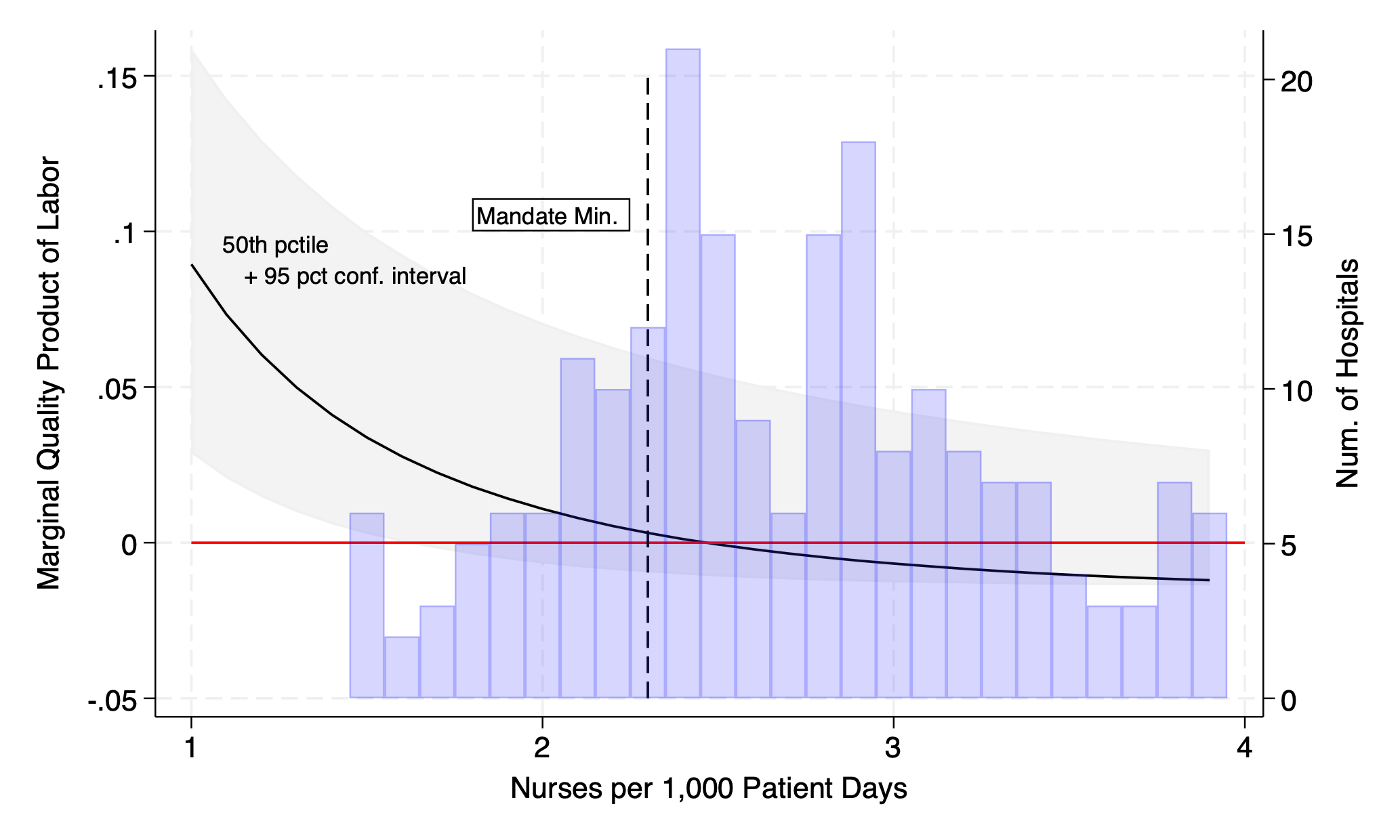
Policy Publications
[1] Ethiopia Gender Diagnostic Report: Priorities for Promoting Equity with Niklas Buehren, et al., World Bank, 2019
[2] Data-Driven Decision Making in Fragile Contexts: Evidence from Sudan (Chapters 2-4) with Naomi Crowther, et al., World Bank, 2017
[3] Inequalities in Public Services in Sudan: Using a Perceptions-Informed View to Drive Policy in Education, Health, and Water Provision with Naomi Crowther, et al., U.K. Department for International Development, 2014
[4] Tailored Finance and Organic Growth: A Livelihoods Approach to Financial Inclusion in India with Rossi Abi-Rafeh, et al., Winner of the InterMedia and Gates Foundation Open Data Challenge Grand Prize, 2014